Originally published in april 2022 and fully updated in July 2026.
When temperatures rise in Hamilton, your car’s air-conditioning system should provide fast and consistent relief from the heat. If the vents begin blowing warm or only slightly cool air, something within the system is no longer working correctly.
The problem may involve low refrigerant, a leak, a failing compressor, restricted airflow or an electrical fault. Because several components work together to cool the cabin, the symptom alone does not always identify the source of the problem.
Professional car A/C repair in Hamilton can determine why the system is no longer cooling properly before refrigerant is added or parts are replaced unnecessarily.
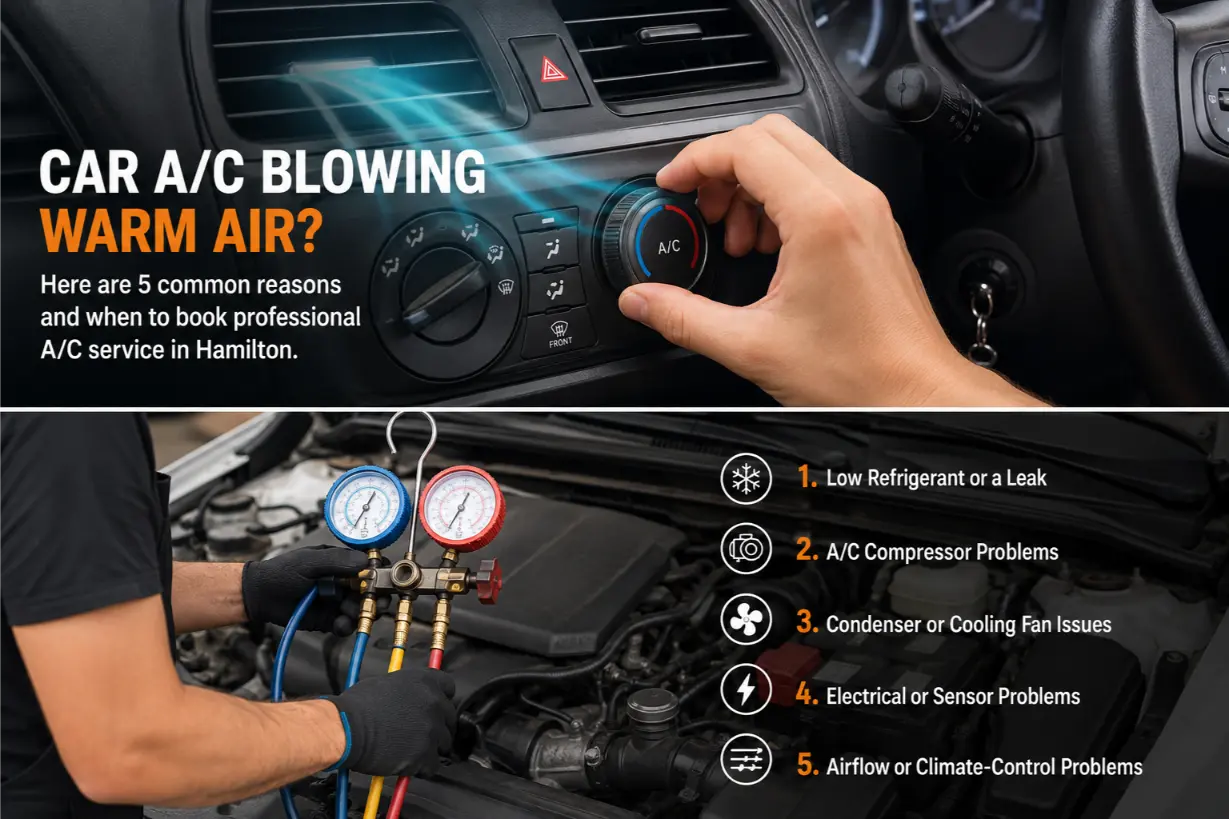
Here are five common reasons your car A/C may be blowing warm air and the warning signs that indicate it is time to schedule an inspection.
How Your Car’s A/C System Produces Cold Air
Your vehicle’s air-conditioning system removes heat and humidity from the air before sending cooled air through the vents.
To accomplish this, refrigerant circulates through a closed system that includes several important components:
- the compressor;
- the condenser;
- the evaporator;
- an expansion valve or orifice tube;
- refrigerant lines and hoses;
- pressure sensors;
- cooling fans;
- electrical controls.
The compressor moves refrigerant through the system. The condenser releases heat outside the vehicle, while the evaporator absorbs heat from the air entering the cabin.
The system also depends on fans, sensors, actuators and electronic controls. A failure in any of these areas can reduce cooling performance or stop the A/C from producing cold air altogether.
Before booking service, pay attention to how the problem behaves:
- Does the A/C cool only while the vehicle is moving?
- Does it blow cold air at first and then become warm?
- Is one side of the cabin cooler than the other?
- Is the airflow weak even when the fan is set to high?
- Do you hear clicking, grinding or rattling when the A/C is turned on?
- Does the A/C stop working in slow Hamilton traffic?
These details can help a technician identify which part of the system should be tested first.
1. Low Refrigerant or a Refrigerant Leak
Low refrigerant is one of the most common reasons a car A/C system begins blowing warm air.
However, refrigerant is not like engine oil or windshield washer fluid. It should not normally be consumed during regular vehicle operation. The A/C system is designed to remain sealed, so a low refrigerant level usually indicates that refrigerant has escaped through a leak.
Leaks may develop around:
- hoses and fittings;
- seals and O-rings;
- service ports;
- the condenser;
- the evaporator;
- the compressor shaft seal;
- damaged refrigerant lines.
A small leak may reduce cooling performance gradually. The air may still feel somewhat cool, but the system may take longer to lower the cabin temperature.
A larger leak can cause the A/C to stop cooling much more quickly.
Signs that refrigerant may be low
Possible warning signs include:
- the air is cooler than the outside temperature but not properly cold;
- the A/C takes longer than usual to cool the cabin;
- cooling performance changes from one drive to another;
- the compressor frequently turns on and off;
- greasy or oily residue appears around an A/C fitting or hose;
- the A/C worked after a previous recharge but soon became warm again.
Simply adding more refrigerant may provide temporary cooling, but it does not repair the source of the leak.
Ontario guidance for vehicle A/C refrigerants recommends checking for a leak before refrigerant is added to the system. Refrigerant work also requires the correct equipment, product and handling procedures.
A professional inspection may include pressure testing, visual inspection and an appropriate leak-detection method. Once the leak is located, the damaged component or seal can be repaired before the system is recharged to the correct specification.
2. The A/C Compressor Is Not Working Properly
The compressor is responsible for circulating refrigerant and creating the pressure changes required to remove heat from the cabin.
If the compressor does not engage or cannot build the correct pressure, the vents may continue blowing warm air even when the A/C is set to its coldest setting.
Possible compressor-related problems include:
- internal wear or mechanical damage;
- a damaged compressor clutch;
- low refrigerant pressure;
- a failed fuse or relay;
- a faulty pressure sensor;
- wiring problems;
- incorrect signals from the climate-control module;
- inadequate lubrication caused by refrigerant loss.
Some compressor problems develop gradually. Others cause the A/C to stop cooling without much warning.
Signs of a possible compressor problem
Watch for symptoms such as:
- clicking, rattling or grinding when the A/C is switched on;
- the compressor does not engage;
- the air changes repeatedly between cold and warm;
- the A/C stops working after several minutes;
- the engine idle changes noticeably when the A/C is activated;
- a drive belt squeals while the system is running.
A compressor is one of the more complex and costly parts of the A/C system. That does not mean it should automatically be replaced whenever the vents blow warm air.
A pressure sensor, relay, wiring problem or low refrigerant level may prevent a functioning compressor from turning on. Proper diagnostic testing is therefore important before a compressor replacement is recommended.
3. The Condenser or Cooling Fan Has a Problem
The condenser is normally installed near the front of the vehicle, close to the radiator. Its purpose is to release the heat carried by the refrigerant after it leaves the compressor.
Because of its position, the condenser is exposed to:
- dirt;
- insects;
- leaves;
- road debris;
- stones;
- winter salt;
- corrosion.
If airflow through the condenser becomes restricted, the system may have difficulty releasing heat. This can cause weak or inconsistent cooling, particularly when the vehicle is stopped or travelling slowly.
The condenser can also be punctured or damaged by road debris. Even a small opening may allow refrigerant to escape.
Why cooling-fan operation matters
Many vehicles use electric cooling fans to draw air across the condenser when the car is stopped or moving slowly.
If a fan motor, fuse, relay, sensor or control circuit fails, there may not be enough airflow to remove heat from the refrigerant.
A common symptom is an A/C system that works better at highway speed but begins blowing warmer air while:
- idling;
- waiting at a traffic light;
- driving in stop-and-go traffic;
- sitting in a parking lot;
- moving slowly during heavy Hamilton traffic.
At higher speeds, natural airflow passes through the condenser. When the vehicle stops, the electric fan must provide that airflow.
A blocked condenser and a failed cooling fan can create similar symptoms, so both should be inspected before repairs are recommended.
Watch for engine-temperature warnings
A cooling-fan problem may affect more than the A/C system. In some vehicles, the same fans also help control engine temperature.
If the temperature gauge rises, a warning light appears or the engine begins overheating, turn off the A/C and arrange an inspection through professional automotive repair services in Hamilton.
An overheating engine is more urgent than an uncomfortable cabin. Continuing to drive an overheating vehicle may cause substantial engine damage.
4. An Electrical or Sensor Problem Is Interrupting the System
Modern automotive climate-control systems rely on electronic components to monitor temperature, refrigerant pressure and driver settings.
A problem with one electrical component may prevent the compressor or cooling fans from operating, even when the main mechanical components are still functional.
Possible electrical causes include:
- a blown fuse;
- a failed relay;
- damaged wiring;
- a loose electrical connection;
- a faulty pressure sensor;
- a cabin temperature sensor problem;
- an ambient temperature sensor problem;
- a defective control panel;
- a climate-control module fault.
The vehicle may intentionally disable the compressor when a sensor reports pressure or temperature readings outside the safe operating range. This protects the system from possible damage, but it also means that the vents will not produce cold air until the original fault is identified.
Why a simple code scan may not be enough
Some climate-control problems store diagnostic trouble codes, but reading a code does not necessarily identify the failed component.
A complete diagnosis may involve:
- scanning the relevant control modules;
- testing voltage and electrical continuity;
- checking fuses and relays;
- monitoring pressure-sensor readings;
- verifying whether the compressor is receiving a command to operate;
- testing cooling-fan activation;
- comparing sensor readings with actual temperatures and pressures.
Replacing a fuse may restore the system temporarily, but a fuse that blows repeatedly indicates an underlying electrical fault. Continuing to replace it without diagnosing the cause is not a permanent repair.
5. Airflow or Climate-Control Components Are Not Working Correctly
Sometimes the refrigerant and compressor are functioning, but cooled air is not reaching the cabin properly.
This may happen because of a clogged cabin air filter, a failed blower motor, a damaged actuator or a blend door that is stuck in the wrong position.
A clogged cabin air filter
The cabin air filter removes dust, pollen and other airborne particles before air enters the passenger compartment.
Over time, the filter can become clogged and restrict airflow through the vents. The air itself may still be cold, but the low volume of airflow can make the A/C feel ineffective.
Signs of a clogged cabin air filter may include:
- weak airflow from the vents;
- increased fan noise;
- unpleasant odours;
- dust entering the cabin;
- windows taking longer to clear;
- limited airflow even when the fan is set to high.
Replacing a dirty cabin air filter may improve airflow, but it will not correct a refrigerant leak, electrical problem or compressor failure.
A blower motor problem
The blower motor pushes conditioned air through the vents.
If the motor is failing, the airflow may:
- operate only at certain fan speeds;
- stop intermittently;
- become weaker than normal;
- produce unusual noises;
- stop completely.
A failed blower resistor or control module may also cause the fan to work at some speeds but not others.
A stuck blend door or failed actuator
Inside the dashboard, small doors control where air flows and how much heated or cooled air enters the cabin. These components are commonly moved by small electric actuators.
If a blend door becomes stuck or an actuator fails, the system may:
- blow warm air even when cold is selected;
- cool the driver’s side but not the passenger side;
- make a repetitive clicking sound behind the dashboard;
- fail to respond when the temperature setting is changed;
- direct air from the wrong vents.
A blend-door problem can easily be mistaken for low refrigerant because both may cause warm air at the vents. However, adding refrigerant will not repair a failed actuator or stuck airflow door.
Accurate diagnosis is especially important because some dashboard components can be difficult to access.
Why You Should Be Careful With DIY Recharge Kits
A DIY recharge kit may appear to be an easy solution, but warm vent air does not automatically mean the system only needs more refrigerant.
The same symptom can be caused by:
- a failed cooling fan;
- a blocked condenser;
- an electrical problem;
- a pressure sensor;
- a blend door;
- a blower motor;
- a compressor fault.
Adding refrigerant without measuring the existing charge can result in too much refrigerant being placed in the system. Incorrect pressure can reduce cooling performance and may damage components.
Vehicles may also use different refrigerants and service fittings. The correct refrigerant type and quantity are normally listed on a label under the hood or in the vehicle manufacturer’s service information.
Mixing products, adding the wrong refrigerant or using a leak-sealing product can complicate future diagnosis and service.
A proper approach is to determine:
- whether the refrigerant level is actually low;
- whether the system has a leak;
- where the leak is located;
- whether an electrical or mechanical fault is preventing operation;
- which refrigerant and service procedure the vehicle requires.
What Happens During a Professional A/C Inspection?
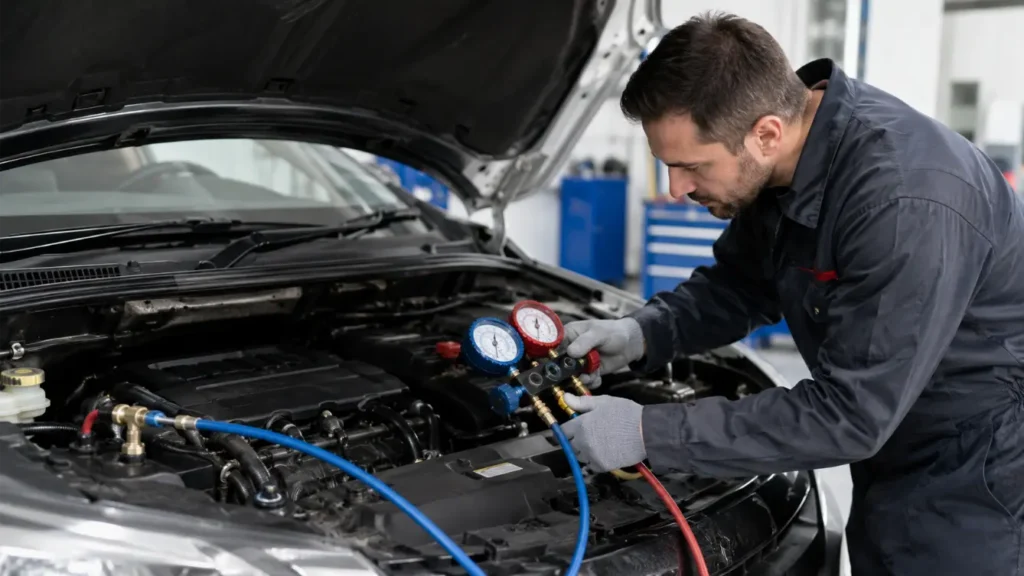
A professional A/C inspection should focus on identifying the reason for the cooling problem rather than automatically adding refrigerant.
Depending on the vehicle and symptoms, an inspection may include:
- measuring the temperature of the air leaving the vents;
- checking whether the compressor engages;
- inspecting the compressor and drive belt;
- measuring system pressures;
- checking for refrigerant leaks;
- inspecting hoses and accessible connections;
- examining the condenser for damage or blockage;
- verifying cooling-fan operation;
- checking fuses, relays and wiring;
- scanning the climate-control modules;
- inspecting the cabin air filter;
- testing blower-motor operation;
- checking temperature-door and actuator operation.
CRS Automotive’s A/C and heating service is intended to identify leaks, pressure problems, component malfunctions and other conditions that may prevent the system from cooling properly.
Once the source of the problem has been identified, the technician can explain which repair is required and whether any related maintenance should be completed.
Drivers can also include A/C performance checks as part of their broader vehicle maintenance service in Hamilton, particularly before summer travel or extended periods of hot weather.
Can You Drive When Your Car A/C Is Blowing Warm Air?
In many cases, an A/C system that blows warm air will not immediately prevent the vehicle from being driven. However, the accompanying symptoms are important.
Arrange an inspection promptly if:
- the engine temperature begins to rise;
- a temperature warning light appears;
- the compressor makes grinding or rattling sounds;
- a belt begins squealing;
- you notice a burning smell;
- the cooling fans are not operating;
- the system stops working suddenly;
- the windows cannot be cleared effectively;
- fluid appears to be leaking from the vehicle.
A functioning A/C system does more than make the cabin comfortable. It also removes moisture from the air and supports the defrost and defog functions.
If the A/C problem affects visibility or is accompanied by engine overheating, unusual noises or warning lights, it should be investigated as soon as possible.
When Should You Book Car A/C Service?
Book an inspection when you notice that:
- the air is no longer as cold as it used to be;
- the system takes too long to cool the cabin;
- cooling performance is inconsistent;
- the A/C works only while driving;
- airflow from the vents is weak;
- one side of the vehicle is warmer than the other;
- unusual noises occur when the system is activated;
- the A/C produces unpleasant odours;
- the system repeatedly loses cooling after being recharged.
Diagnosing the problem early may help prevent additional component damage and reduce the chance of the system failing completely during hot weather.
You can also review how to check whether your car A/C is ready for a Hamilton summer before temperatures reach their seasonal peak.
Book A/C Repair in Hamilton With CRS Automotive
If your car A/C is blowing warm air, avoid guessing which part needs to be replaced or repeatedly adding refrigerant without identifying the underlying problem.
CRS Automotive can inspect the complete system, determine why it is not cooling properly and recommend the appropriate repair for your vehicle.
Schedule professional car A/C repair in Hamilton before the next period of hot weather, or contact CRS Automotive to discuss the symptoms you are experiencing.
We are located only 3 min driving South West of Little Rays Reptile Zoo and Nature Centre and 4 min driving South West of Hamilton Indoor Go Karts.
Frequently Asked Questions
Why does my car A/C blow cold air at first and then turn warm?
This may be caused by incorrect refrigerant pressure, evaporator icing, a failing compressor, an electrical fault or a faulty sensor. Testing the system while the problem is occurring can help identify the cause.
Why does my car A/C work only when I am driving?
The system may not be receiving enough airflow across the condenser while the vehicle is stopped. A failed cooling fan, blocked condenser or pressure problem may be responsible.
Does warm air always mean the refrigerant is low?
No. Low refrigerant is only one possible cause. Compressor problems, electrical faults, faulty sensors, blocked airflow and blend-door failures can produce similar symptoms.
Can a dirty cabin air filter cause warm air?
A dirty cabin filter normally restricts the amount of air coming from the vents rather than changing the refrigerant temperature. However, weak airflow can make the A/C feel as though it is not cooling effectively.
Can I add A/C refrigerant myself?
Vehicle A/C systems require the correct refrigerant type, pressure and charging quantity. Adding the wrong refrigerant or too much product can reduce performance, contaminate the system or cause damage. The system should also be checked for leaks before refrigerant is added.