As the world is changing its ways and attempting to be more ecologically conscious (for the most part, anyway), the automotive industry is slowly turning in the direction of electric vehicles. Manufacturers are jumping into the electric market and are at their starting points to begin a head-to-head race with gas and diesel-powered vehicles.
Note: Come and talk with our car experts if you are in the market to buy a new car. Our specialists at the Cambridge premium used car dealership can help.
As Tom Standage, Deputy Editor at The Economist, has stated, 2018 will be the first time it will effectively be cheaper to buy an electric car instead of a gas or diesel-run one – the total cost of ownership of an electric vehicle will be lower than that of the cars currently in mass use. To be more precise, even though the initial costs of purchasing an electric vehicle are higher than gas or diesel ones, when you calculate the amount of money to be saved on fuel and maintenance or repairs, it more than makes up for the starting costs.
According to Forbes, electric car purchasing prices have come down in 2017 by 11% from the previous year. For example, the price of Hyundai Ioniq (124-mile range) begins at $22.000, with Nissan Leaf (107-mile range) at $30.000, followed by Tesla Model 3 (220-mile range) at $35.000 and Chevrolet Bolt (238-mile range) which price begins at $37.500. If you are taking out a loan to buy an electric vehicle, the process itself won’t differ much than that of for a fossil-fuel vehicle, but you could get special discounts or incentives for purchasing such a vehicle. As with all types of vehicles, when it comes to the car insurance costs, the determining factors are not only your driving record and insurance history, but also the safety reputation of the vehicle – the safer the car, the lower the cost. Moreover, the resale values for electric cars may not be as high as they are for ICE vehicles simply because they are still new to the automotive market and the average driver. The one deterrent from selling an EV for a good price is buyers’ reluctance to change the battery as they are still pretty expensive (even when compared to the initial purchase cost of the vehicle). However, that in itself is not a reason enough to switch to a (used) electric vehicle, since the battery is cannot last forever, and must be replaced as soon as there is a change in the charging intervals.
When it comes to the maintenance electric vehicles need, things are much simpler – and more economical – here than with fossil-fuel vehicles.
First of all, EVs have fewer moving parts, which automatically translates into less worrying about what can be worn out from driving and when the time to replace it is. For example, the electric motor has only one moving part as opposed to internal combustion engines (ICE) which are made of dozens. Second of all, even with the vehicle systems that do require maintenance and repair from time to time, everything is done in a much quicker and simpler way:
- The battery needs to be monitored for the shortening in intervals between charges – the more time passes the less charge it holds
- Brake wear needs to be assessed from time to time – since EVs use the regenerative braking system, they will probably last twice as long than on ICE vehicle
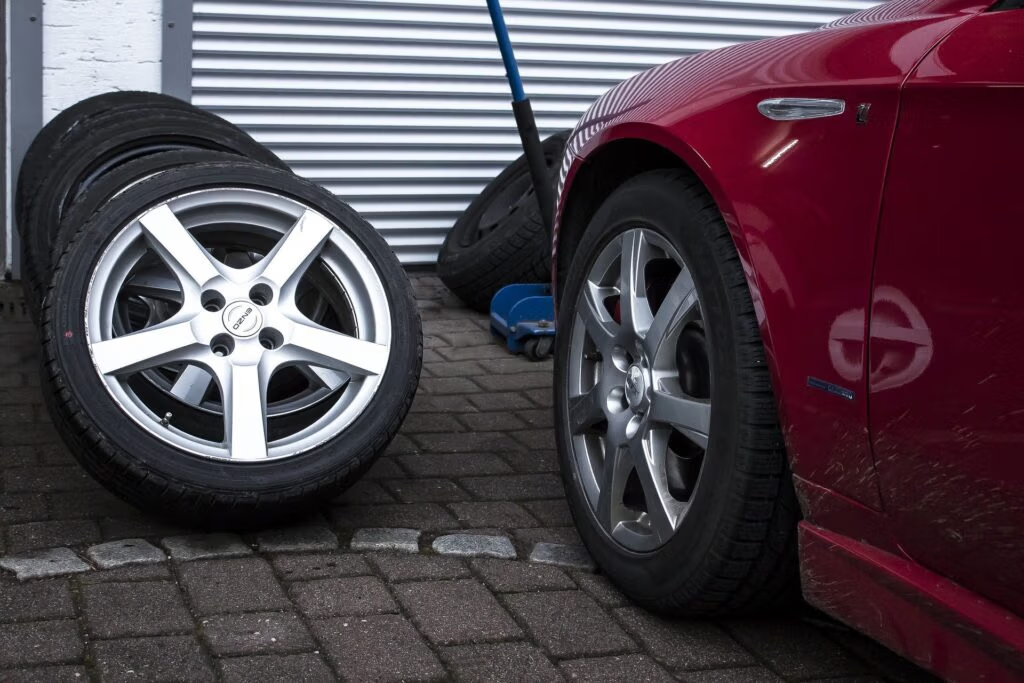
- Tires have to be checked for wear more often than on ICE cars – heavier vehicles and instant torque can be hard on them
- All the fluids EVs use need to be topped up regularly – being more sensitive to temperature fluctuations, they usually require more fluids to function properly
- Cabin air filters need to be replaced – keeping the air inside the vehicle clean is also a major concern for EV manufacturers
- Software updates should be installed regularly to ensure a smooth and safe ride – you can do it on your own or at your trusted mechanic’s shop
- Vehicle body should be taken care of – even if all that means is washing and waxing your car regularly and properly
There are, however, vehicle components that EVs simply don’t have, thus giving you one less thing to concern yourself with when it comes to owning an electric vehicle:
- Fuel
- Muffler
- Spark plugs and wires
- Motor oil
- Automatic transmission fluid
- Radiator fluid.
Having listed all of the things you need to pay attention to when it comes to the maintenance of electric vehicles, and more importantly – the ones you don’t, it is a worthy inclusion that EVs will cost you less than ICE vehicles to maintain. But, we cannot forget one thing – an EV still needs to run on something, right? Let’s see how much it costs to charge an EV.
A home charging unit is a must for EV owners – like fossil fuels are for ICE car owners. Yes, you can stop at charging points every now and again, but those are just to get you through to the next one on a long journey and eventually your destination. If you have your heart set on properly owning an electric vehicle, those aren’t enough – you need a home charging unit.
There are 3 types of home charging units:
- Level 1 (110V – standard household outlet) – up to 8-20 hours to fully charge an EV
- Level 2 (240V – similar to clothes dryer plug) – 4-6 hours to fully charge an EV
- Level 3 (480V – Direct Current Fast Charger) – 30 minutes to charge 80% of EV battery.
According to the Ministry of Transportation, a typical battery EV costs about $0.78 per day to charge at night or under $300 per year, a typical hybrid costs $1.92 per day (with gas and electricity costs) or around $700 per year, while ICE vehicles in the same class cost between $1.000 and $2.000 per year just to fuel – up to 8 times more per day!
AutoTrader.ca had similar findings when comparing the 2017 Chevrolet Bolt EV, an average BEV hatchback, to the 2017 Honda Civic sedan as a vehicle of a similar constitution and the best-selling car in Canada in 2017.
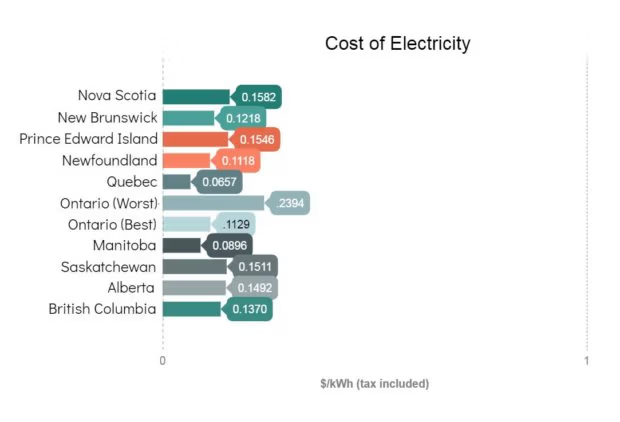
The Chevy Bolt uses 17.6kWh/100km, so the worst case scenario – if you are in rural Ontario, where electricity is the most expensive – is that 100km worth of charge will cost you $4.21. However, if you mean to charge it at night or any time on off-peak weekends, as most EV owners do, the cost drops to just $2.36. If you aren’t in a rural area, the cost is just $1.99. Conversely, the Honda Civic gets 7L/100km in combined driving. With the average price of regular in Canada being $1.05/L, 100km of driving such a car costs around $7.35 (assuming the Civic reaches its official mileage figure).
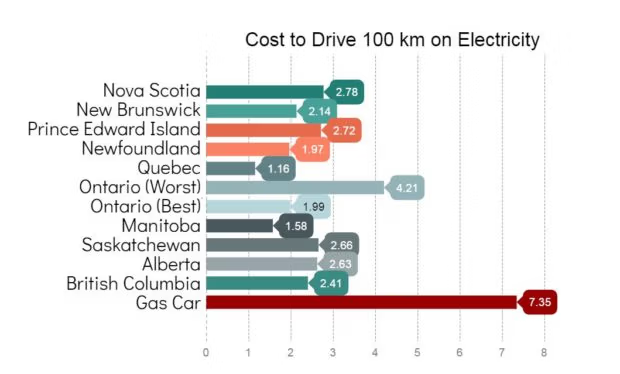
Therefore, an EV costs between 20% and 50% as much it does to fill the tank of a fossil-fuel car.
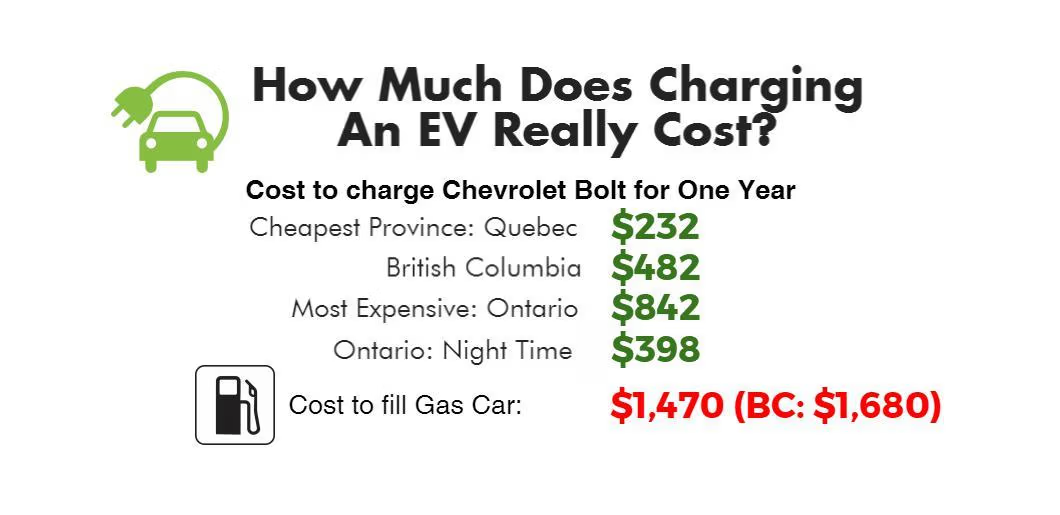
All in all, given that the total cost of ownership of electric vehicles is already lower than that of diesel or gas-powered ones, we can only expect the demand to increase. Couple that with the prices of EV batteries going down and the adoption of emission-free vehicles, and we will be having a completely different landscape on the automotive market.
Nevertheless, you will always need mechanical services of the highest quality, so come to our repair shop in Hamilton, and we will take excellent care of your vehicle. We are expecting you!
We are located only 4 min walking South West of Tim Hortons Field and 4 min walk West of Bernie Morelli Recreation Centre.