
Are Winter Tires A Legal Requirement?
Provinces and territories decide individually if winter tires are a legal requirement. Installing winter tires is mandatory province-wide during the winter driving season in Quebec and on designated routes in British Columbia. What about Ontario, specifically Hamilton Ontario? Winter tires are recommended but not compulsory. Some insurance providers offer a discount on auto insurance if you install winter tires, so check with your insurer on their policy.Ideal Time To Install Winter Tires
It’s good practice (and just plain sensible, really) to get on with installing winter tires on your vehicle as soon as temperature dips below +7°C or before the first snowfall – whichever comes first! The reason for that is that the rubber in all-season tires starts to harden, resembling a hockey puck when the temperature drops below +7°C. The harder it gets, the fewer traction tires have. On the other hand, winter tires are made with rubber that stays softer in the cold giving increased traction, braking and handling on cold and dry pavement. They also have treads designed to grip ice and snow. Therefore, as soon as you are able to see your breath, it’s time to change your tires.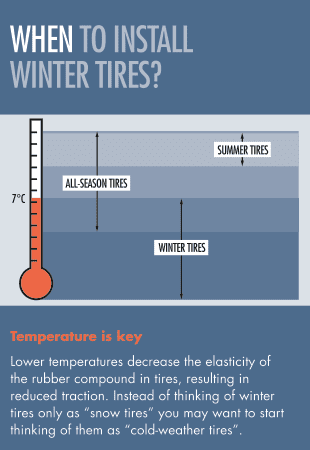 Should you want to be diligent in your winter vehicle preparations in Hamilton – and would like to avoid the rush at your trusted mechanic’s shop – October is not too soon to install winter tires. Many drivers have encountered this specific problem before and have chosen not to go through the ordeal ever again, so they’ve made it their annual routine.
Pros Of Installing Winter Tires
The pros for installing winter tires are numerous and well documented: “Tests conducted by Transport Canada and the Rubber Association of Canada have demonstrated that all-season tires veered off the testing track at speeds of 40-50 km/h; this didn’t occur with cars with winter tires. A study by the Quebec government concluded that proper winter tires on your vehicle improves braking by up to 25% over all-season radials and improves collision avoidance by about 38%. Winter tires that are in good condition offer better stability during braking and a shorter stopping distance. They also improve the motorist’s ability to keep a vehicle on course while turning.” “In comparison tests between all-seasons and winter tires in normal temperatures, it took winter tires an average of 7 meters further to stop from 96.5 km/h on a dry track. On a wet track, it took winter tires 9.4 meters further to stop.”, states TRAC.Install Winter Tires In Sets Of Four
Another important thing when it comes to installing winter tires is that it should be done in sets of four to help maintain control and stability of your vehicle in icy conditions. Anything less than installing four identical winter tires at the same time compromises your vehicle’s safety and the overall effectiveness of winter tires.Installing only 2 winter tires on the same axle is quite dangerous as it leads to a false sense of confidence and may cause the driver to oversteer or understeer: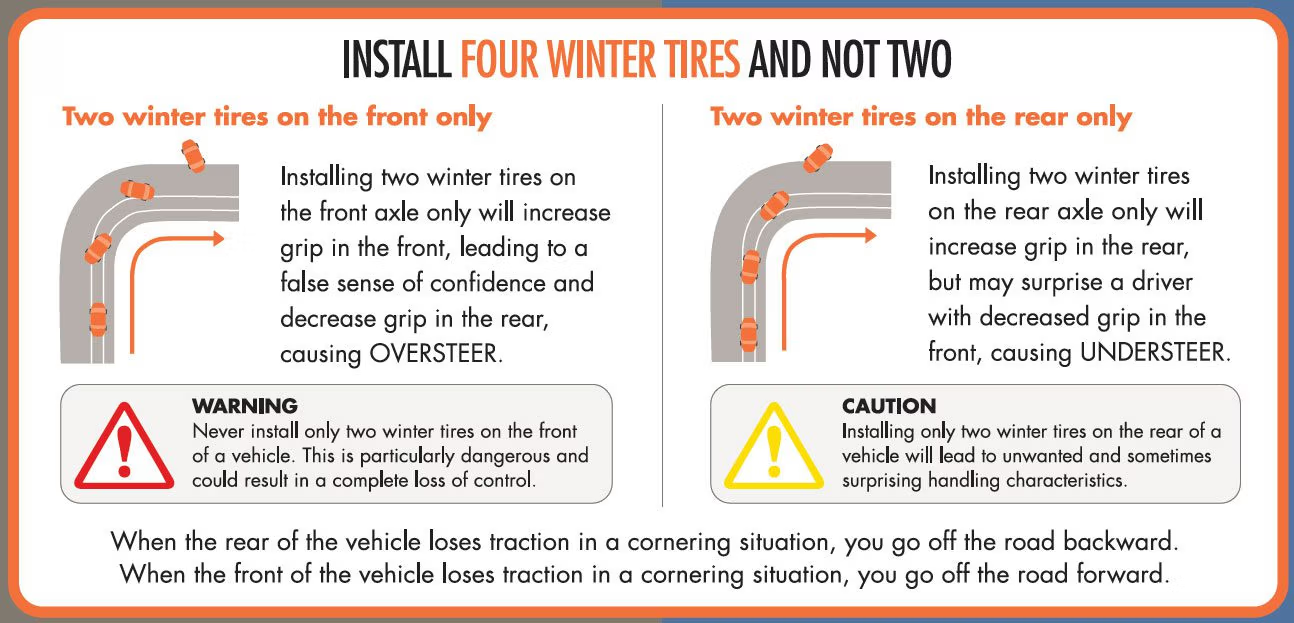 Depending on where you live and drive in Hamilton Ontario, how you drive and store your car during the winter, and whether your tires are properly inflated, balanced and wheels aligned, a set of four winter tires should last approximately 80.000-120.000 kilometers. (For more tips on how to extend the life of your tires, check out this blog post.)
In that sense, these are the questions you need to ask yourself when choosing the right tires for your vehicle:
Depending on where you live and drive in Hamilton Ontario, how you drive and store your car during the winter, and whether your tires are properly inflated, balanced and wheels aligned, a set of four winter tires should last approximately 80.000-120.000 kilometers. (For more tips on how to extend the life of your tires, check out this blog post.)
In that sense, these are the questions you need to ask yourself when choosing the right tires for your vehicle:- Are cold temperatures common where you live?
- Do you have to use your vehicle every day?
- Do you drive on icy or snowy roads?
- Do you drive off main streets and roads in winter?
How Do You Identify Winter Tires?
If you have never installed winter tires, how would you know you are buying the right product? And what about all-weather tires? Are they not sufficient for the winter season? The best way to identify winter tires is to look for the 3-Peak Mountain Snowflake (3PMS) symbol, which is basically a six-pointed snowflake inside a three-peak mountain. When tires carry this symbol, it indicates they are specially designed for winter driving. It might seem confusing as all-weather tires also have the snowflake symbol, but they do not fall into the winter tire temperature range. What does that mean? Let’s look at the difference between winter and all-weather tires.All-weather tires. The tread pattern includes a blocky tread, and the rubber stays flexible above and below 7°Celsius (C). It is ideal for heavy rain and light snowfall.Winter tires. They have a blocky tread with fine slits that push away slush and grip snow. The rubber stays soft in temperatures below 7° and is the right tire for harsh winters with plenty of snow.What About Studded Winter Tires?
Did you notice tires with studs when you took your car in to have the tires changed? Are you wondering whether your vehicle should have studded tires rather than standard winter tires? If you often drive on roads outside urban areas and major cities, it might be an option, but check if it is legal in your province or the province you are traveling to.How do studded tires work? They are specially designed winter tires with nearly a hundred metal studs embedded in each tire. The studs claw into the layers of ice on the road, increasing tire grip.Visit CRS Automotive Hamilton To Install Winter Tires
Are you unsure when to install winter tires on your vehicle? Seeing as we are almost at the year’s end and winter is nearly upon us, when you have all the corresponding answers, visit your trusted mechanic and consult our certified and experienced technicians here at CRS Automotive Hamilton about the latest tire technology and how tires perform in different environments.Do you have a fleet of vehicles? CRS Automotive Hamilton offers fleet maintenance services where we carry out regular fleet inspections, perform fleet tune-ups, and provide procedures for drivers. Our top priority is to ensure that the fleets using our services are always in top shape, including the winter tires.We will be more than happy to keep you safe this winter. Visit us today to install winter tires at our CRS Automotive repair shop in Hamilton!We are located only 4 min walking South West of Tim Hortons Field and 4 min walk West of Bernie Morelli Recreation Centre.Frequently Asked Questions
When is the best time to install winter tires in Hamilton, Ontario?
Install winter tires when temperatures regularly dip below +7°C or before the first snowfall—whichever comes first. Many Hamilton drivers choose to fit winter tires in October to avoid last-minute demand and ensure safer traction as temperatures fall.
Are winter tires legally required in Ontario?
Winter tires are recommended in Ontario but not legally required province-wide. Some insurance providers may offer discounts for winter tire use, so check your insurer’s policy for possible savings.
Should I install winter tires in sets of four or only on one axle?
Always install winter tires in sets of four. Installing fewer than four identical winter tires can compromise vehicle stability and handling, increasing the risk of oversteer or understeer on icy or snowy roads.
How do I identify genuine winter tires versus all-weather tires?
Look for the 3-Peak Mountain Snowflake (3PMS) symbol—a six-pointed snowflake inside a three-peak mountain—on the tire sidewall. All-weather tires may show a snowflake symbol but are formulated to remain flexible above 7°C, while true winter tires are designed to stay soft below 7°C and have tread patterns optimized for snow and ice.
Do studded winter tires make sense for driving around Hamilton?
Studded tires can improve traction on icy, rural roads but may be unnecessary for primarily urban driving. Check provincial regulations before using studded tires, as legality varies by jurisdiction and can affect where you may legally drive them.