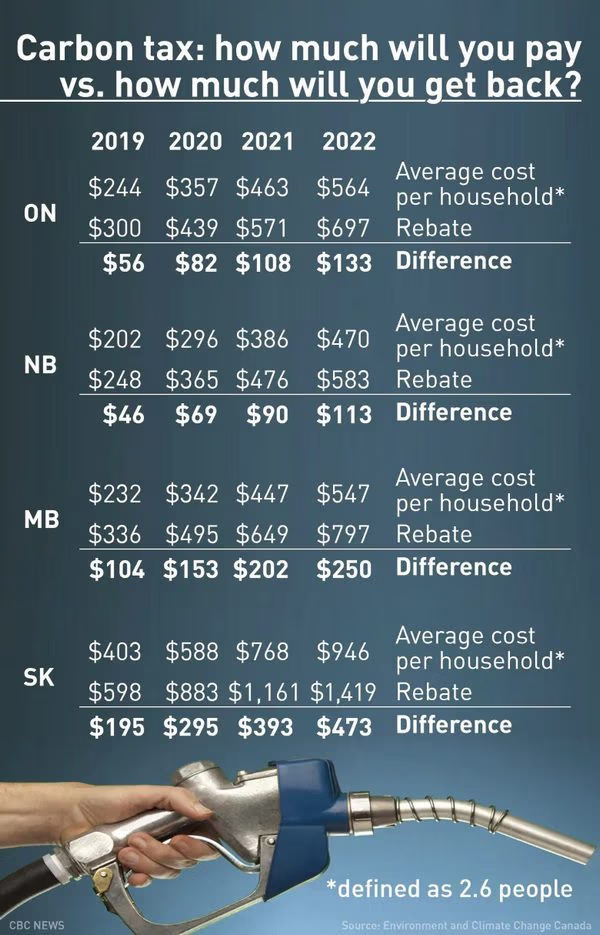
“There is no hiding from climate change,” Trudeau told the House of Commons back in 2016 before the ratification of the Paris accord on climate change. “It is real and it is everywhere. We cannot undo the last 10 years of inaction. What we can do is make a real and honest effort – today and every day – to protect the health of our environment, and with it, the health of all Canadians.”At the same time, Trudeau argued that pricing carbon pollution will give Canada a “significant advantage” in building a cleaner economy, compel businesses to develop innovative ways to reduce emissions and create hundreds of thousands of clean technology jobs. However, even 3 years later, the official data regularly shows that Canada has little chance of meeting its climate change goals of reducing emissions by 30% from 2005 levels by 2030. Enter the carbon tax. But what is it? A carbon tax is a levy on fossil fuels proportional to how much CO2 they release when burned. Coal, for example, releases more carbon pollution than natural gas to produce the same amount of energy. Hence, the federal carbon tax will raise the price of coal more than the price of natural gas. Moreover, the carbon tax doesn’t apply to hydroelectricity and other energy sources that don’t release any carbon pollution. In order to motivate emitters to decrease emissions, the carbon pollution price starts at $20 per tonne of CO2 and will go up slowly over time so households and industries have time to adjust and adopt less carbon-heavy practices. It is expected to rise each year as the carbon tax increases by $10/tonne until it hits $50 in 2022 – meaning it will more than double in less than 3-years’-time. According to the International Institute for Sustainable Development, the carbon tax system protects low-income households and sets aside funds to support municipalities, schools, hospitals, Indigenous communities, and small and medium-sized businesses. Furthermore, the revenues raised in each province are supposed to be returned to the people in that province through an annual tax rebate they can claim on their income tax form. The claimed amount will be the same per person based on the total revenues collected in your province (with a 10% bonus for rural Canadians and those living in small communities). In most cases, the rebate will be more than the price itself, protecting families as it encourages them to reduce costs by taking steps like turning down the heat at night and when no one is home, installing smart thermostats, choosing more fuel-efficient cars and using public transit, walking or biking. Provinces that administer their own price on carbon will continue to use the proceeds as they see fit. Right now that includes rebates, tax cuts, and investments in things like renewable energy projects, industrial and consumer energy-efficiency programs, and transit and infrastructure projects. A province in the backstop (that is, tax) system could opt out at any time in the future to administer its own program. What does all this mean for you? Based on federal figures, the tax in the 4 non-compliant provinces will result in an approximate cost increase of 4.42 cents a liter for gasoline, 5.37 cents for light fuel oil (home heating fuel), 3.91 cents per cubic meter for natural gas and 3.10 cents per liter for propane. Based on those figures, and according to calculations by CBC News, the average Ontario household will pay roughly $10 more a month for natural gas (based on the average of 252 m3 of consumption) as of April 1st. Bear in mind that this figure is prone to fluctuations – it will be considerably lower in the summer but possibly much higher in the winter, when natural gas consumption for home heating spikes. For example, the average Ontario household consumes about 419 m3 of natural gas in January, but only 51 m3 in July. Moreover, the cost to fill an empty residential oil tank, common in places like rural New Brunswick and can vary greatly in size, will increase by about $48 for a 910-liter model. On the other hand, the cost to fully refuel a Honda Civic (based on a 47-liter tank) will increase by about $2, while a full fill-up for a Ford Explorer SUV will cost about $3 more. Consumers will not pay the tax directly to the federal government; rather, the government will impose the tax on fuel and production and distribution companies, which will in turn pass on those costs to customers. However, to compensate for the cost of living increase, Ottawa has vowed to return every single dollar it collects in carbon tax to the people in the province in which it was collected. Some Canadians are already set to receive the “Climate Action Incentive payment” or rebate, which is paid to eligible taxpayers who claim it on their 2018 tax return with the Canada Revenue Agency. Here’s what the average household (defined by Ottawa as 2.6 people) will receive from the federal government:
- in Ontario: about $300 a year,
- in New Brunswick: $248,
- in Manitoba: $336,
- in Saskatchewan: $598.
 In case you are wondering how effective carbon tax incentives are, scientists and economists agree that when the government puts a price on carbon, it raises the incentive for industries and individuals alike to innovate and find ways to lower their emissions.
 In an interview with CBC, Nobel Prize-winning economist Paul Romer said, “If you just commit to a tax on the usage of fuels that directly or indirectly release greenhouse gases, and then you make that tax increase steadily in the future … people will see that there’s a big profit to be made from figuring out ways to supply energy where they can do it without incurring the tax.”Therefore, now that we must find new ways to lower our carbon emissions, let’s do it together. CRS Automotive will help you when it comes to your car. Come to our repair shops in Hamilton today! We are located only 5 min driving North of St. Peter’s Hospital – Hamilton Health Sciences and 6 min driving North of Gage Park.
Frequently Asked Questions
Do you service electric and hybrid vehicles at CRS Automotive?
Yes. CRS Automotive services electric and hybrid vehicles alongside gasoline and diesel cars, light-duty trucks and medium-duty vehicles. Our technicians perform diagnostics, maintenance and repairs specific to electric and hybrid systems.
What types of vehicles and fleets do you support?
We work with all makes and models including cars, light-duty trucks and medium‑duty vehicles. CRS Automotive also provides fleet maintenance and repair services tailored to business vehicles.
How can I book an appointment and what are your hours?
The Hamilton service centre offers online appointment booking for customer convenience and is open seven days a week. Use the online booking tool or contact the shop directly for available slots.
What inspections and diagnostics do you offer?
We provide vehicle inspections, comprehensive engine and electrical diagnostics, dashboard warning light diagnosis, transmission and drivetrain evaluation, and safety system inspections to identify issues and recommend repairs.
Do you offer routine maintenance like oil changes, brakes and tire services?
Yes. CRS Automotive performs preventive maintenance including oil changes, brake inspection and repair, tire installation, balancing and rotation, seasonal tire changes, steering and suspension work, and cooling and HVAC system service.